
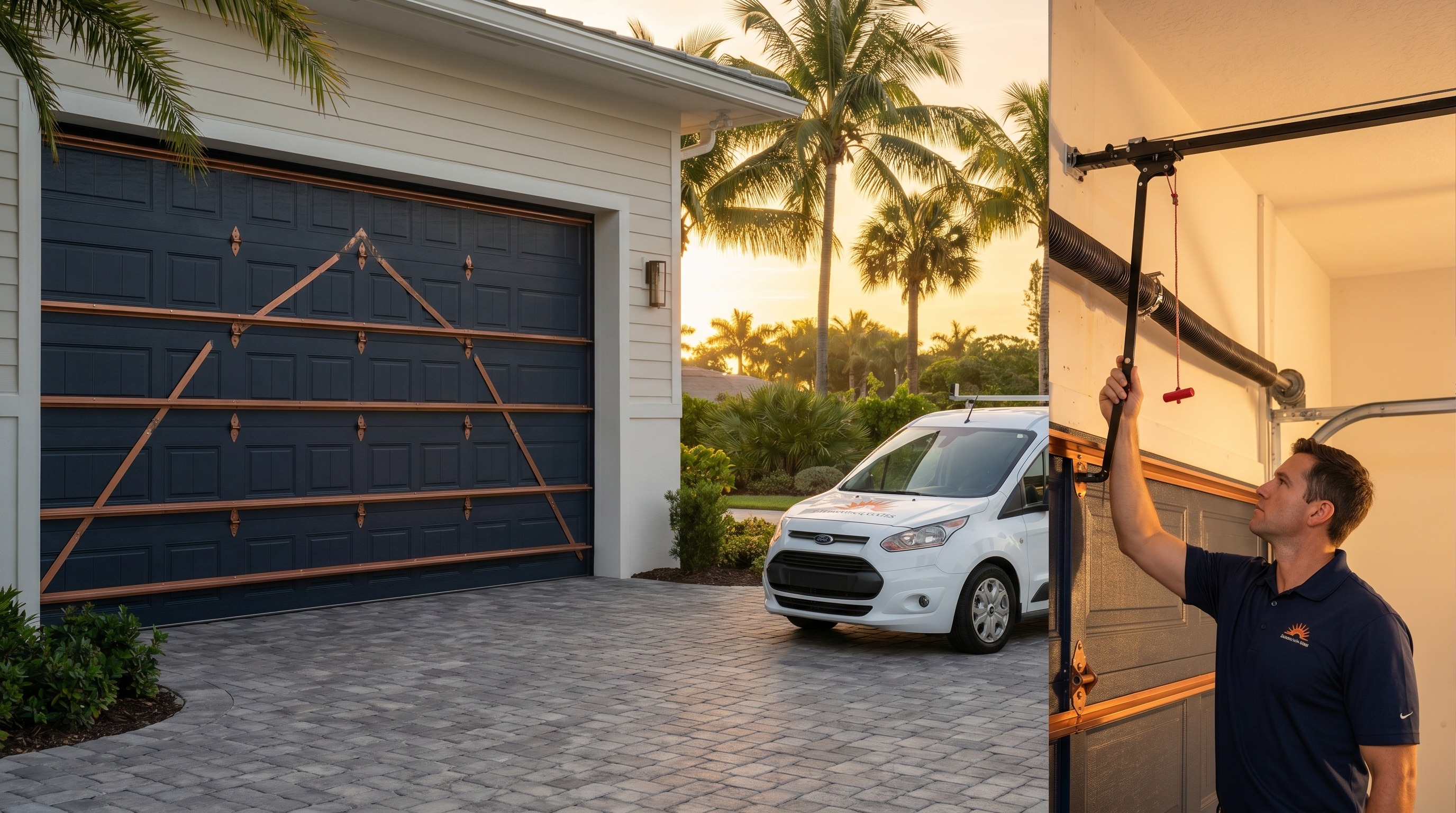
If you own a home anywhere in Florida, your garage door is one of the largest openings in the entire structure â and during a hurricane, it is also one of the most vulnerable. When a garage door fails in a storm, wind rushes inside and pushes up on the roof from below. That sudden internal pressure is a leading cause of catastrophic roof loss in Florida homes. It is exactly why the state writes the rulebook so carefully, and why "hurricane-rated" is not just marketing language here â it is code.
Below, our crews break down what those wind codes mean, what the labels on a rated door are telling you, and how to choose a door that protects your family and passes inspection â just what Florida homeowners from Port St. Lucie to Boca Raton actually need to know.
Why garage doors get special attention in Florida
Most exterior walls are short, braced, and tied into the foundation. A garage door is the opposite: a wide, relatively thin span held in tracks, with nothing behind it. In a hurricane it has to resist two forces at once â the wind trying to push it inward, and the suction trying to peel it outward. If it bows, buckles, or blows out of its tracks, the storm is suddenly inside your home.
That single failure can cascade â internal pressurization lifts the roof and blows out windows. Because of that domino effect, Florida treats the garage door as critical "opening protection," right alongside impact windows and shutters.
The two ratings that matter: design pressure and impact
When people say "hurricane-rated," they are usually blending two separate things. Understanding the difference is the single most useful thing you can learn before buying a door.
Design pressure (wind rating)
Design pressure â often written as DP â measures how much wind force a door can take, in pounds per square foot, in both the positive (push) and negative (suction) directions. A door rated to a higher design pressure resists stronger gusts without bending or pulling free of its tracks. The DP your home requires is calculated from your local design wind speed, your home's height and exposure, and the size of the opening, so the correct number genuinely varies street to street.
Impact rating
An impact rating tells you the door can survive flying debris â a tree branch, roof tile, or piece of a neighbor's fence â striking the panel and then enduring thousands of pressure cycles afterward. Doors earn this through large-missile and small-missile testing. In Florida's High-Velocity Hurricane Zones (HVHZ) â Miami-Dade and Broward counties â impact protection is mandatory for the opening, either built into the door itself or provided by an approved shutter or panel system.
Quick rule of thumb: design pressure is about wind; impact rating is about debris. A truly storm-ready door usually needs both, and in HVHZ counties the law requires it.
Wind speed zones and the building code
The Florida Building Code divides the state into ultimate design wind-speed zones, generally ranging from around 130 mph inland to 170+ mph in the most exposed coastal and HVHZ areas. Your zone, combined with your home's exposure category and the door's dimensions, determines the minimum design pressure your door must meet.
A few practical takeaways:
- Coastal St. Lucie and Palm Beach properties typically require higher design pressures than inland lots in the same county.
- A wider two-car or three-car door faces more total force than a single-car door, so it often needs a stronger rating or reinforcement.
- Two-story homes and homes on open water or open land (higher exposure) carry tougher requirements than a sheltered home in a built-up neighborhood.
This is why a "hurricane door" that satisfied your cousin's house three blocks away may not pass at yours. The number has to be calculated for your opening.
Reading the label: NOA and Florida Product Approval
Every code-approved door carries paperwork, and you want to keep it. There are two approval systems you will encounter:
- Florida Product Approval (FL number) â the statewide approval used in most of Florida, confirming the door meets the tested design pressure for your application.
- Miami-Dade NOA (Notice of Acceptance) â the stricter approval required in the HVHZ counties, confirming the door passed both pressure and impact (missile) testing.
The label or data plate on the door, plus the matching approval document, is what an inspector checks and what your insurer will ask for. Treat it like the title to a car: file it somewhere safe the day your door is installed.
A practical tip on insurance
A code-approved garage door can earn you wind-mitigation credits on your Florida homeowners policy. To claim them you will usually need a wind-mitigation inspection and the door's product-approval documentation. Many homeowners leave money on the table simply because they lost the paperwork â so ask your installer for it in writing and store it with your policy.
Choosing the right hurricane-rated door
Once you know your zone and whether you are in an HVHZ county, choosing comes down to a handful of decisions our crews walk customers through every week:
- Material: Steel doors with internal reinforcement are the most common choice for Florida's wind loads. On coastal and barrier-island homes, ask about corrosion-resistant hardware and finishes â relentless salt air will chew through cheap springs, rollers, and tracks long before the panels wear out.
- Construction: Look for insulated, multi-layer panels with reinforcing struts. Insulation also helps with our year-round humidity and heat, keeping the garage â and any rooms above it â more comfortable.
- Impact glass: Want windows in the door? In HVHZ areas and many coastal zones they must be impact-rated too. Beautiful and compliant are not mutually exclusive.
- HOA compliance: Plenty of Florida communities dictate color, panel style, and window layout. We help you stay storm-safe and HOA-approved so you are not redoing the job in six months.
If you are also protecting a property line or driveway, the same storm-smart thinking applies to your driveway gates and operators â wind load, corrosion, and operator hold-down all matter for gates too.
What about my existing door?
Not every older door has to be ripped out. Some doors can accept a manufacturer-approved retrofit bracing kit that raises their design-pressure rating. But bracing has limits: it cannot turn a non-impact door into an impact-rated one, and it only works when the kit is engineered for that exact door and track system. A quick inspection from a licensed installer tells you whether your door qualifies for reinforcement or is better replaced â see our full breakdown of options on the garage doors service page.
When to call a pro
Hurricane rating is one of those areas where a do-it-yourself shortcut can quietly void your protection â and your code compliance. Call a licensed Florida installer when:
- You are buying a new home or replacing a door and need the correct design pressure calculated for your address.
- Your current door bows, rattles, or rebounds in normal wind â early warning signs it will not hold in a storm.
- You want to add a bracing kit and need to confirm it is approved for your specific door.
- You are claiming wind-mitigation insurance credits and need the right product-approval documentation.
- A storm is in the forecast and your door is acting up â that is what our 24/7 emergency service is for.
Our crews live and work in the same weather you do, from the Treasure Coast to South Florida. We will measure your opening, calculate the rating you actually need, handle the permitting and product-approval paperwork, and install a door built for Florida storms â not just stamped with a sticker. We would rather you be ready before the cone ever shows up on the news.
Ready for a storm-smart garage door?
Get a free, no-pressure estimate from a licensed Florida crew. We will confirm the wind rating your home needs and handle the paperwork â sunrise to sunset, seven days a week.