
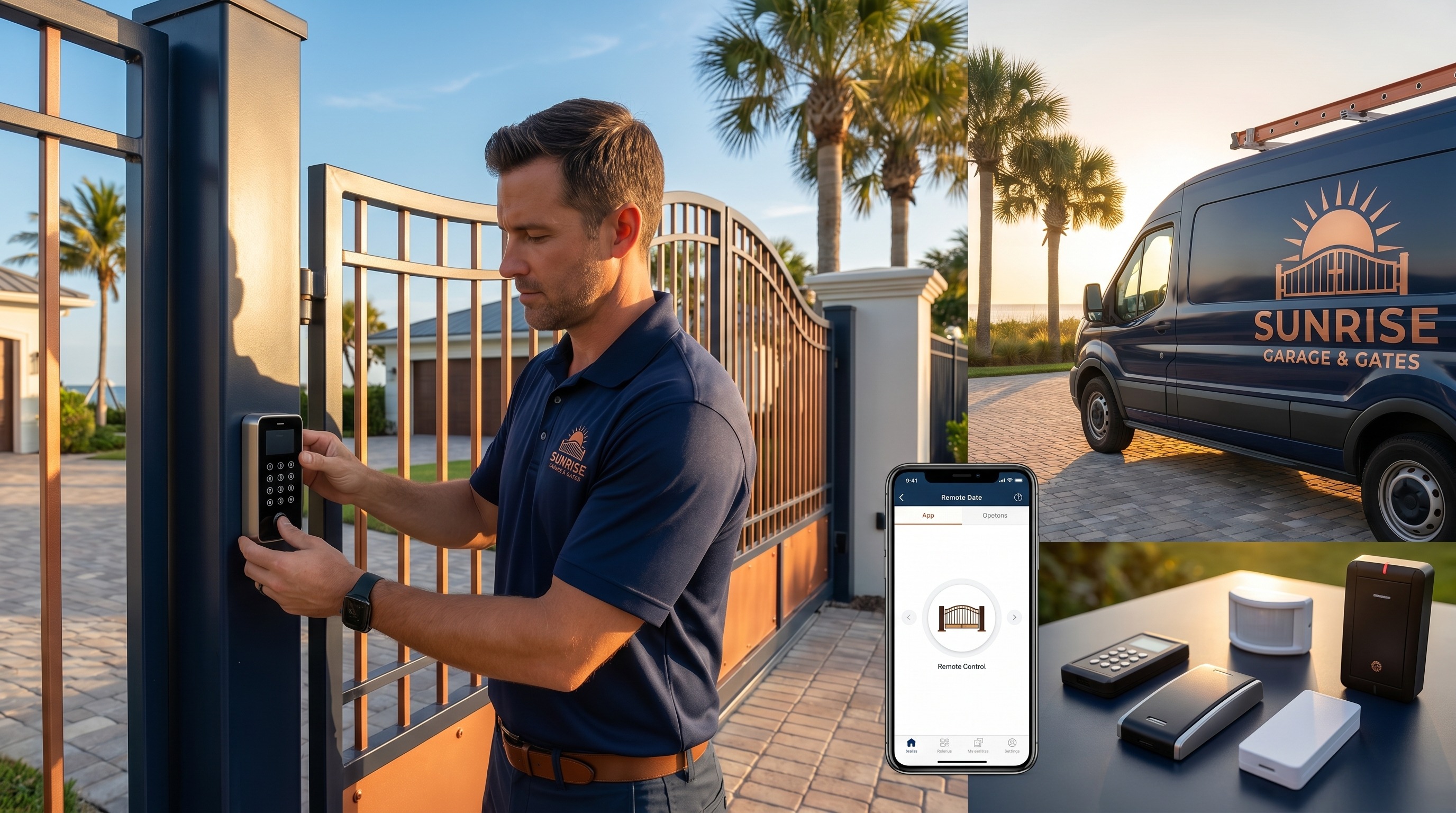
A driveway gate is only as useful as the way you open it. We install and service gates from Port St. Lucie up the Treasure Coast and down through Boca Raton and the Palm Beaches, and the question we hear most often is not "swing or slide?" â it is "how do my guests, my landscaper, and my delivery driver actually get in?" That is the job of an access control system, and in Florida it has to do that job in driving summer rain, relentless sun, and salt air that eats cheap hardware alive.
This guide walks through the real options â keypads, intercoms, telephone entry, RFID and transmitters, and smartphone entry â with the trade-offs that matter for a home, an HOA community, or a coastal business. The goal: help you pick a system that is easy on a normal Tuesday and still standing after hurricane season.
What "access control" actually means at a gate
Access control is the layer that tells your gate operator who may open the gate and how they prove it. The operator is the motor that swings or slides the gate; the access device is what a person interacts with at the pedestal. Most properties combine two or three methods â one for owners, one for regular visitors, and one for the occasional guest or vendor. There is no single "best" choice, only the right mix for how your property is used.
The four ways people get through a gate
- You and your household â usually a transmitter, RFID tag, or smartphone app for hands-free, daily entry.
- Expected visitors â a keypad code or a call from an intercom so you can buzz them in.
- Vendors and deliveries â a temporary code, a delivery PIN, or a call-button that rings your phone.
- Emergency services â a Knox box, Click2Enter, or strobe sensor so fire and EMS are never locked out.
Keypads: the workhorse of gate entry
A wired or wireless keypad mounted on a gooseneck pedestal is the most common entry method we install, and for good reason. It is inexpensive, dead simple for guests, and lets you hand out a numeric code instead of a physical fob. Good keypads support multiple codes, so you can give the pool service its own PIN and delete it the day they stop coming.
The catch in Florida is the environment. A bargain keypad with a thin membrane will fog, corrode, and stick within a season or two near the coast. We specify metal-faced, gasketed keypads rated for outdoor wet locations, and we still recommend a small rain hood over any pedestal that faces afternoon storms.
Field tip: change your "master" gate code at least twice a year, and always after a contractor finishes a project. An old landscaping crew with a code they never forgot is the most common "how did they get in?" call we get.
Intercoms and telephone entry: see and talk to your visitor
When you want to confirm who is at the gate before it opens, an intercom is the answer. There are two broad families.
Video and audio intercoms
A traditional intercom links the gate pedestal to a station inside the home (or several stations). Press the call button at the gate and it rings inside; you talk, you look at the camera feed, and you press a button to release the gate. These are reliable, work without internet, and are popular for single homes where someone is usually home.
Telephone (cellular) entry
Telephone-entry systems ring your actual phone â cell or landline â when a visitor presses call. You answer from anywhere, talk to the person, and press a digit to open the gate. This is the workhorse for gated driveways and small communities because you do not have to be home to let someone in. Modern units use a cellular module, so they keep working with no landline. For HOA entrances, a directory-style panel lets visitors scroll to a resident's name and dial them directly.
RFID tags, transmitters, and loop detectors
For the people who come and go every day, entry should be effortless. That is where credentials and sensors come in:
- Remote transmitters (clickers): the classic visor remote â cheap, no wiring at the gate, easy to add or revoke.
- RFID tags and stickers: a windshield sticker or hang-tag read by a pedestal antenna as you roll up, so residents never lower a window.
- Long-range readers: read a credential from 10â30 feet so the gate is already opening as you arrive.
- Exit loops: a wire loop in the driveway that detects your vehicle and opens the gate automatically on the way out.
On the coast, antenna housings and loop wiring take a beating from moisture and lightning. We use direct-burial loop wire and surge protection on the operator board, because one summer storm can knock out an unprotected control panel.
Smartphone entry and cloud access
Smartphone-based gate access has gone from novelty to mainstream, and for good reason. With a cellular-connected controller, you open the gate from an app, get a notification (and often a photo) when someone arrives, and grant access without ever cutting a key or programming a remote.
What smartphone systems do well
- Remote-grant access: let a guest, cleaner, or family member in from your phone while you are at work in West Palm Beach or on the boat.
- Scheduled and temporary codes: issue a PIN that works only Tuesday 9â11 a.m. for the lawn crew, then expires on its own.
- Audit trail: a time-stamped log of every entry â invaluable for rentals and small businesses.
- Delivery integration: many systems pair with carrier apps so a verified driver gets a one-time entry.
What to watch for
Smartphone systems lean on cellular signal and power. We always pair them with a battery backup so the gate still opens during a storm outage, and we confirm signal strength at the pedestal before we commit to a cellular controller â a gate at the back of a wooded lot may need an external antenna. If you want a deeper look at the gate hardware itself, our driveway and security gate page covers operators, materials, and finishes built for Florida.
Choosing the right mix for your property
Here is the short version of how we steer customers, after thousands of Florida installs:
- Single-family home, someone usually here: a transmitter or app for the household plus a video intercom for visitors.
- Home with frequent vendors or a rental: smartphone control with temporary codes, backed by a weatherproof keypad.
- HOA or gated community: a directory telephone-entry panel, RFID for residents, and a free-exit loop. See our commercial and community gate services for shared-entry setups.
- Business or storage yard: long-range readers or app control with a full audit log and scheduled access for staff.
Whatever the mix, two non-negotiables apply to every Florida gate: a battery backup so an outage does not trap you, and an emergency-access method (Knox box, Click2Enter, or strobe sensor) so fire and EMS can reach the property â many county codes require the latter. If you ever get stuck behind a dead gate, our 24/7 emergency gate team can get you moving.
A quick word on salt air and humidity
Coastal Florida is brutal on access hardware. Stainless or powder-coated pedestals, gasketed enclosures, dielectric grease on connections, and surge protection are the difference between a system that lasts a decade and one that fails after eighteen months. On a coastal property in Hutchinson Island, Jupiter, or Delray Beach, corrosion resistance is built into our spec, not an upsell.
When to call a pro
You can swap a visor remote or change a keypad code on your own. But once you are running 120V or low-voltage wiring to a pedestal, tying into a gate operator board, setting up a cellular controller, or wiring an emergency-access device, it is time to bring in a licensed installer. Mis-wired surge protection, an under-sized power supply, or a non-compliant emergency-entry setup can cost far more than the original install â and a gate that fails to release for EMS is a genuine safety problem.
Our crews work statewide, from the Treasure Coast to the Palm Beaches, and we will walk your property, check cellular signal, and recommend a mix that fits how you actually live or run your business. If a gate problem cannot wait, we answer the phone around the clock. You can also explore upgrades for the rest of your entrance on our garage door services page or reach out for a free estimate.
Ready to upgrade your gate access?
Get a free, no-pressure estimate on keypads, intercoms, RFID, or smartphone entry â engineered for Florida sun, storms, and salt air.