
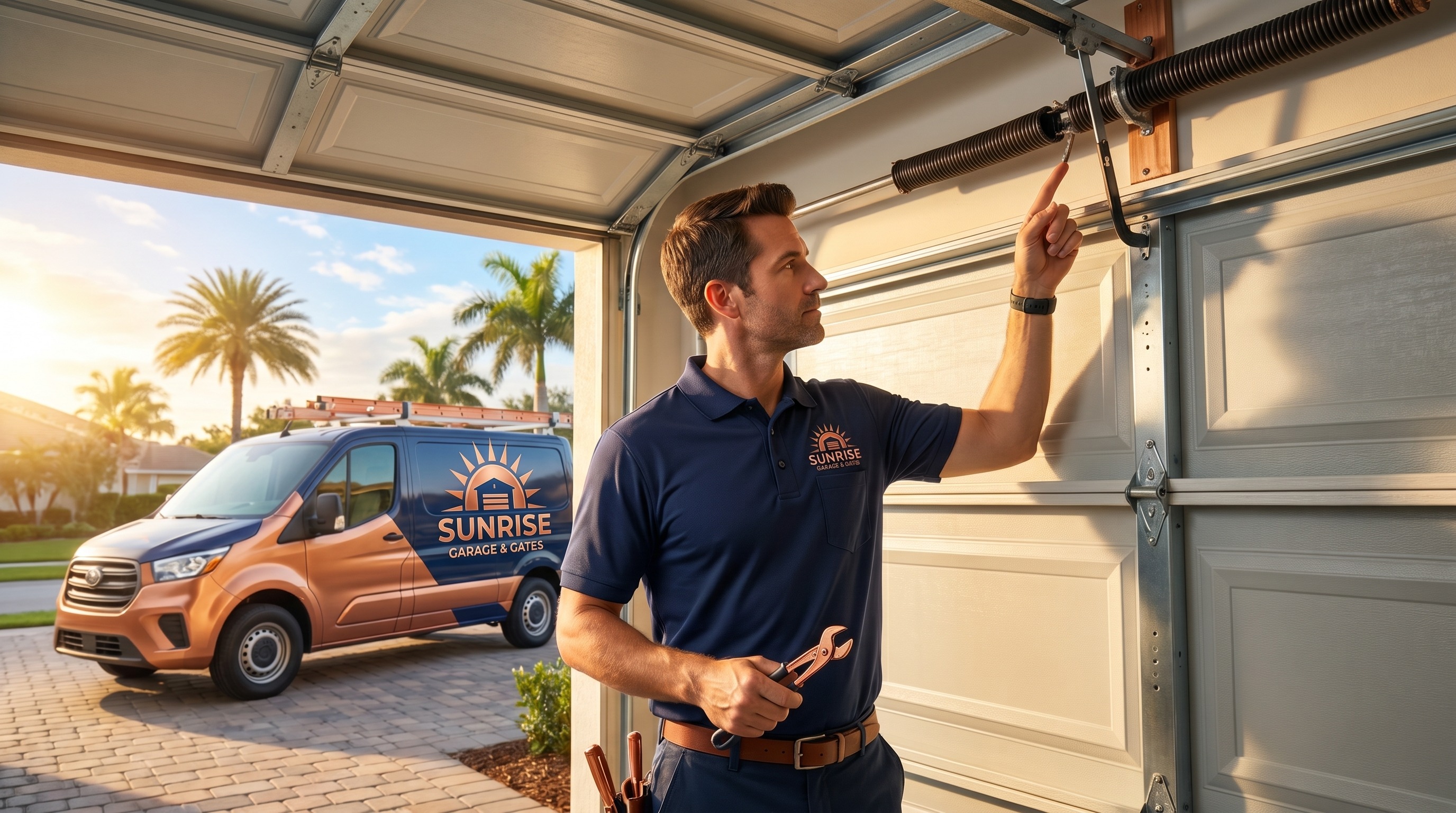
It is 7:30 on a humid Tuesday morning in Port St. Lucie, you are already late, and the garage door just sits there mocking you. The opener hums, or clicks, or does absolutely nothing â and your car is trapped inside. Before you panic, take a breath. A surprising number of "stuck" doors come down to a tripped sensor, a dead remote battery, or a switch someone bumped over the weekend.
This guide walks you through the safe checks any Florida homeowner can do before calling for help â and it is honest about the moments you should stop and pick up the phone, because a few garage-door parts store enough force to send you to the ER. Let's figure out what is going on.
Start With the Easy Wins
Roughly half the "my door won't open" calls we get across St. Lucie and Palm Beach County turn out to be simple. Rule these out first, in order, before you touch anything mechanical.
1. Check the power
Florida's afternoon storms trip breakers and flicker power constantly, and a brief outage can knock an opener offline. Confirm the ceiling outlet actually has power â plug in a phone charger to test it â then check your breaker panel for a tripped switch labeled "garage." If you recently had a lightning storm or surge, the opener's logic board may have taken a hit, which we will come back to.
2. Look for the disconnect cord
That red rope dangling from the opener rail is the manual release. If someone pulled it â kids, a houseguest, or you during the last outage â the door is disconnected from the motor. With the door closed, push the cord toward the motor until the trolley clicks back in, then try the opener again.
3. Swap the remote battery and try the wall button
If the wall button opens the door but the remote does not, you have your culprit: a dead remote battery or one that needs re-programming. Salt air and heat are hard on those little coin batteries. If neither the remote nor the wall button works but the opener has power, the issue is likely the opener itself or something blocking the door.
Quick tip: Keep a spare CR2032 or CR2016 battery in a kitchen drawer. In our humid climate, remote batteries fade faster than the manufacturer's estimate â a 30-second swap beats a service call.
The Safety Sensors: Florida's Most Common Offender
Every garage door opener made since the early 1990s has two small photo-eye sensors near the floor, one on each side of the door. They shoot an invisible beam across the opening, and if anything breaks it the door will not close â and on many models gets confused and refuses to open smoothly either.
Here in Florida these sensors get knocked out of alignment constantly. Lawn equipment, hurricane-prep clutter shoved against the wall, a stray pool noodle, even a spider building a web across the lens (we have very enthusiastic spiders) can break the beam. Walk down to floor level and look:
- Are the little LED lights on both sensors glowing steady? A blinking or dark light means they are misaligned or blocked.
- Is anything sitting in the door's path â a recycling bin, a bike, a bag of potting soil?
- Are the lenses caked with dust, pollen, or that fine coastal grit? Wipe them gently with a dry microfiber cloth.
- Has a sensor been bumped so it points slightly off? Nudge it by hand until both LEDs glow solid.
Realigning a sensor is genuinely a two-minute DIY fix, and it resolves a huge share of "won't open" complaints. If the lights still will not cooperate after cleaning and aligning, the wiring may be chewed or corroded â that is where a technician comes in.
Listen to the Door â The Sound Tells the Story
What you hear when you press the button narrows things down fast.
The motor hums but the door doesn't move
The opener is trying, but something is stopping the door. This often points to a broken torsion spring â the heavy coiled spring above the door that does the real lifting. The motor is not strong enough to raise a door on its own; the springs counterbalance the weight. When one snaps (you may have heard a bang like a firecracker), the motor strains uselessly. Do not keep pressing the button â you can burn out the motor.
You hear a loud bang, then nothing
That is almost always a spring or a cable. A snapped cable can let the door slam down hard and crooked. Both parts are under extreme tension and are the number-one cause of serious garage-door injuries. This is a stop-and-call situation, full stop.
Grinding, scraping, or the door jams partway
A door that opens a few inches and binds or scrapes usually has a track problem: a bent rail, a worn roller, or debris in the channel. Florida garages also fight rust on springs and hardware thanks to year-round humidity and, near the coast, salt air. Minor track debris you can clear; bent metal you should not try to bend back yourself.
A Few Things You Can Safely Check
- Test the manual lift (carefully). With the opener disconnected and the door closed, try lifting it by hand. A balanced door rises smoothly and stays put around waist height. If it is brutally heavy or crashes back down, the springs are failing â reconnect and call us.
- Check the lock. Some doors have a manual slide lock or a vacation lock mode on the keypad. Make sure no one engaged it.
- Inspect the rollers and hinges. A roller off its track or a loose hinge can stop everything â you can spot these even if you do not fix them.
- Look at the travel limits. If the door reverses immediately or stops short, the force or limit settings may have drifted â common after a power surge.
What NOT to Touch
We want you to save money where you safely can â and we also want you keeping all ten fingers. Please never attempt to adjust, loosen, or replace:
- Torsion or extension springs. They hold hundreds of pounds of force and require winding bars and training. This is the single most dangerous DIY garage repair.
- Lift cables. Same extreme tension, same risk.
- The bottom bracket. It is connected to the cables and is under load.
If your troubleshooting points to any of these parts, stop and let a trained Florida crew handle it. A spring replacement is routine for us and genuinely dangerous for a homeowner with a wrench.
Why Florida Doors Act Up More Than Most
Our climate is tough on hardware. Daily humidity rusts springs, hinges, and fasteners faster than in drier states. Coastal homes in places like Hutchinson Island, Jupiter, or Boca Raton fight salt-air corrosion that pits metal and seizes rollers. Hurricane season brings power surges that fry opener boards. Doors built and maintained for these realities â including wind-rated systems that meet Florida building codes â simply last longer. If your door is older or has never been serviced, a stuck morning is often the first symptom of wear that has been building for a while. Our garage door repair and installation team sees this every week.
When to Call a Pro
Call us right away if you notice any of these:
- A loud bang followed by a door that won't move, or a visible gap in a coiled spring above the door.
- A cable hanging loose, frayed, or off its drum.
- A door that is crooked, jammed in the track, or far too heavy to lift by hand.
- An opener that is dead after a storm, or that smells like burnt electronics.
- Any situation where your car is trapped and you have somewhere to be â that is exactly what our same-day and 24/7 emergency service is for.
Sunrise Garage & Gates runs local crews across St. Lucie and Palm Beach County, with upfront pricing and a workmanship warranty. We handle garage doors, openers, and springs â and if it turns out your driveway gate or operator is acting up too, we cover those as well. Got questions before you book? Reach out through our contact page and we will point you in the right direction.
Still stuck? We'll get that door moving.
Free estimates, honest diagnostics, and same-day service across Florida â sunrise to sunset.