
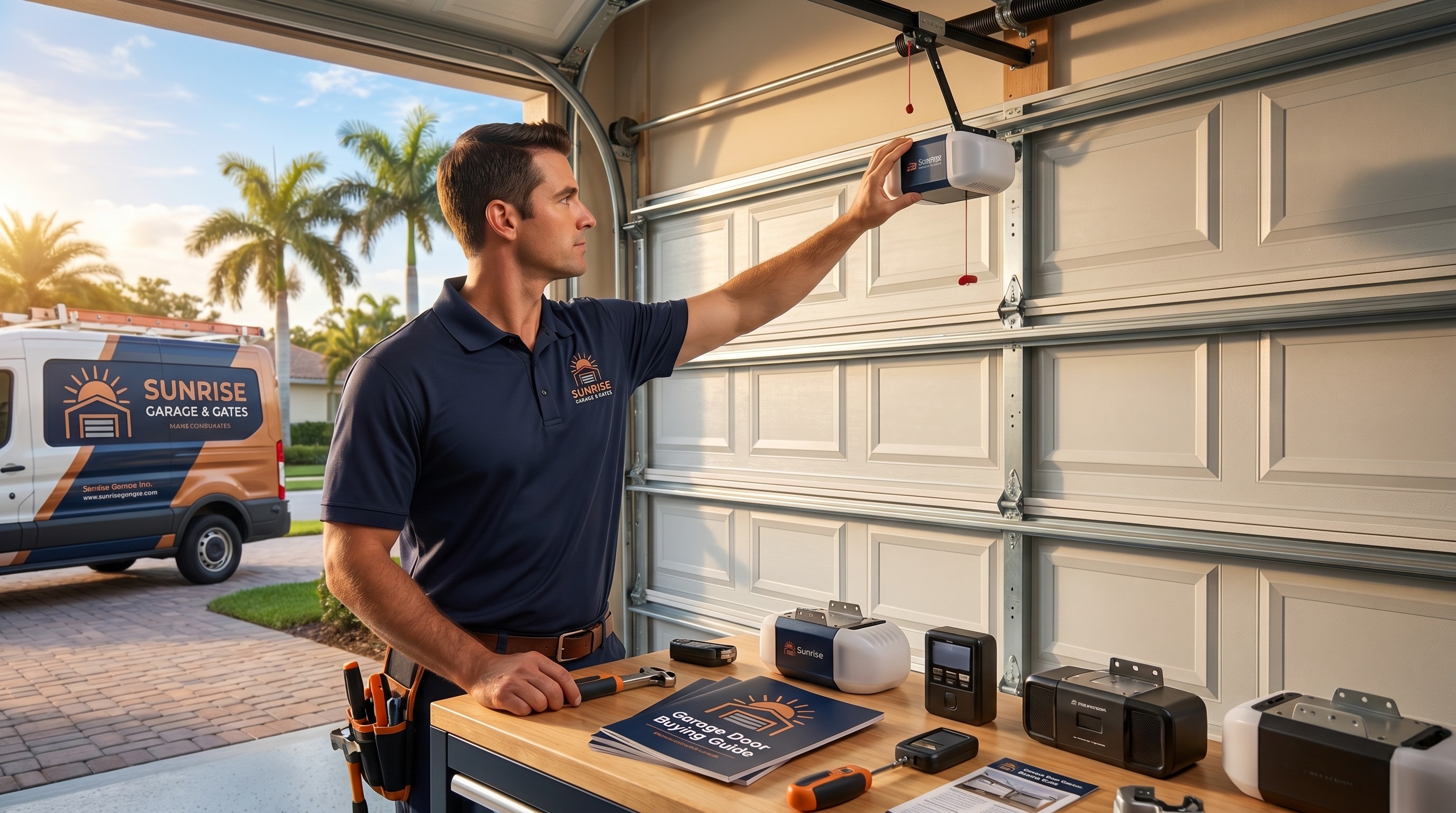
Your garage door opener is the hardest-working motor in your house. In a typical Florida home it cycles four to six times a day, every day, through August humidity, salt breeze, and the occasional hurricane-season power flicker. So when the old unit starts grinding, dropping the door, or losing its remote signal, the question isn't just "which opener is cheapest" — it's "which opener will actually survive coastal Florida and keep my family safe."
After installing and repairing thousands of openers from Port St. Lucie down to Boca Raton, we've learned exactly what holds up here and what doesn't. This guide walks you through the four drive types, the horsepower you really need, and the features that matter when you live a few miles from the Atlantic.
The Four Drive Types, Explained
Every residential opener moves your door using one of four mechanisms. The drive type sets the noise level, the maintenance schedule, and a good chunk of the price.
Chain-Drive Openers
The old workhorse. A metal chain (like a bicycle chain) pulls the door up its track. Chain drives are the most affordable and brutally reliable, but they're also the loudest — you'll hear that classic rattle through the bedroom wall. They're a smart pick for a detached garage or a workshop where noise doesn't matter. In our salt-air zip codes, the trade-off is that the chain needs lubrication a couple of times a year or it will corrode and stretch.
Belt-Drive Openers
Same idea as a chain, but a reinforced rubber or fiberglass belt does the lifting. The result is a near-silent ride with far less vibration. If you have a living space, bedroom, or home office directly above or beside the garage — common in Florida's two-story coastal builds — a belt drive is usually the best all-around choice. There's also nothing metal to rust in the drive path, which we love for homes on the barrier islands.
Screw-Drive Openers
A threaded steel rod spins to slide the trolley along, with fewer moving parts than a chain or belt. Screw drives handle heavy doors well — but here's the Florida catch: the lubricant on the rod can get gummy and sluggish in our heat-and-humidity cycle. They're a niche pick now that belt drives have come down in price.
Wall-Mount (Jackshaft) Openers
Instead of a rail running across the ceiling, this unit mounts on the wall beside the door and turns the torsion bar directly. It frees up overhead space for storage or a higher-clearance vehicle, runs quietly, and almost always ships with a built-in battery backup. It costs more, but for a clean modern garage — or any home where the ceiling rail is in the way — it's a fantastic upgrade.
How Much Horsepower Do You Need?
Opener motors are rated in horsepower (HP) or, on newer DC models, in horsepower-comparable (HPc) terms. Bigger isn't automatically better; it's about matching the motor to the door's weight.
- 1/2 HP — Fine for a standard single-car aluminum or lightweight steel door.
- 3/4 HP — The sweet spot for most Florida homes, and a must for heavy two-car doors, insulated doors, or solid-wood and faux-wood styles.
- 1 HP and up — For oversized, carriage-house, or hurricane-rated impact doors, which can weigh well over 300 pounds.
This matters more here than almost anywhere else. A wind-code-compliant impact-rated garage door is significantly heavier than a builder-grade door, and pairing it with an undersized 1/2 HP motor is a recipe for a burned-out opener two summers from now. When in doubt, size up.
Florida-Specific Features Worth Paying For
This is where a generic big-box buying guide falls short. The features below aren't luxuries in our climate — they're the difference between an opener that lasts a decade and one you'll be calling us about.
Battery Backup (Non-Negotiable Here)
When a summer storm or a hurricane knocks out power, a battery-backup opener still lets you get your car out — and lets you get back in without wrestling the manual release in the dark. We strongly recommend it on every install in our service area.
Corrosion Resistance
Salt air is relentless on the barrier islands and anywhere within a few miles of the coast. Look for sealed motors, stainless or coated hardware, and a belt drive rather than bare metal chain. It's a small spec line that pays off on Hutchinson Island and in the beachside Boca neighborhoods.
Smart / Wi-Fi Connectivity
Modern smart openers connect to your home Wi-Fi so you can open, close, and check the door's status from your phone — anywhere. Forgot whether you closed it before the drive to work? Check the app. Expecting a delivery while you're out? Let them in and close it behind them. Most platforms (myQ, Aladdin Connect, and similar) also send alerts and work with smart-home assistants.
Practical tip: before you buy a smart opener, confirm your garage actually gets a solid Wi-Fi signal. Detached garages and homes with thick block-and-stucco walls — very common in Florida — often need a mesh node or extender out there first.
Rolling-Code Security
Any opener you buy today should use rolling-code technology, which generates a new code every time you press the remote so the signal can't be copied. Pair that with a smart opener's activity log and you've closed the most common backyard break-in loophole.
Quiet DC Motors & HOA Rules
If you live in a deed-restricted community — and a huge share of Florida homeowners do — check your HOA's rules before you assume anything. Some have noise expectations or restrict exterior remote keypads. A quiet belt drive with a DC motor and soft start/stop keeps the peace with neighbors and the board alike.
Quick Comparison: Which Opener Fits You?
- Bedroom above or beside the garage: Belt drive, 3/4 HP, battery backup, Wi-Fi.
- Detached workshop, budget-minded: Chain drive — just keep it lubricated against the salt air.
- Coastal / barrier-island home: Belt or wall-mount with corrosion-resistant hardware.
- Heavy impact or carriage-house door: 1 HP+ wall-mount or belt drive, sized to the door's weight.
- Tech-forward household: Smart Wi-Fi opener with rolling code and a phone app.
Don't Overlook Your Door — or Your Gate
An opener is only as good as the door it lifts. If your springs are tired, your rollers are worn, or your tracks are bent, even the best new motor will struggle and wear out early. It's worth having the whole system inspected when you upgrade — we cover that in detail on our garage door service page. And if you also have a driveway entrance, the same logic applies to your automatic gate operator, which faces even harsher sun and salt exposure than your garage motor does.
When to Call a Pro
Plenty of homeowners are comfortable programming a remote or swapping a battery. But opener installation isn't a basic plug-and-play job, and a few situations call for a licensed technician every time:
- Your door uses a torsion spring — these store enormous force and can cause serious injury if handled wrong. Never adjust them yourself.
- The opener has to be matched to a heavy or impact-rated door with the correct horsepower and reinforcement.
- You want the safety sensors, auto-reverse, and force settings calibrated to code — the features that stop a closing door on a child or pet.
- You're integrating battery backup, Wi-Fi, or smart-home gear and want it done right the first time.
At Sunrise Garage & Gates, our local Florida crews install every major opener brand, size the motor to your exact door, and dial in the safety settings before we leave — backed by upfront pricing and a workmanship warranty. If your opener fails at the worst possible moment, our 24/7 emergency team can get you back in and out fast, day or night.
Ready for a quieter, smarter, storm-ready opener?
Get a free, no-pressure estimate from a licensed Florida technician — we'll recommend the right opener for your door, your home, and your budget.