
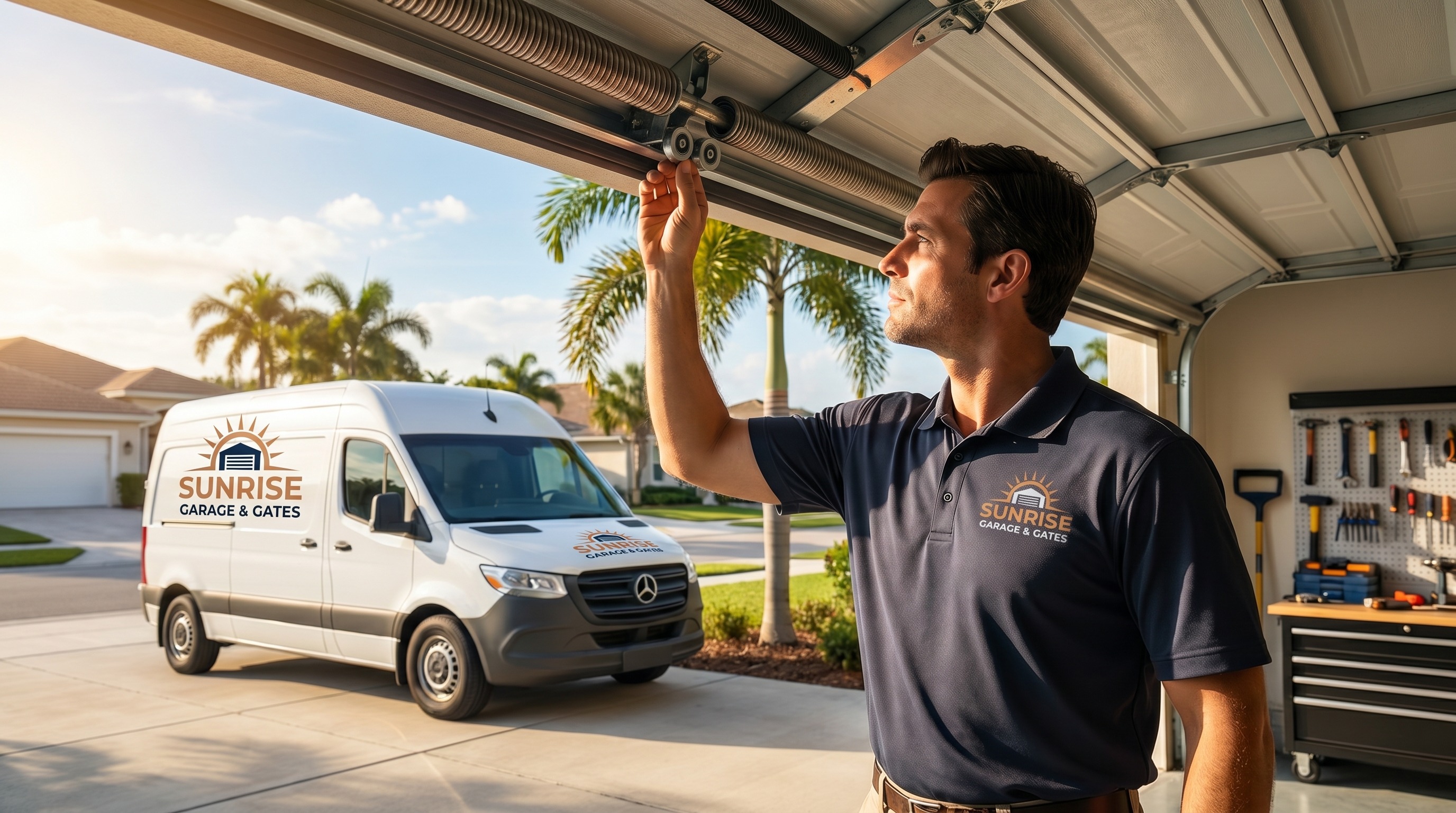
Your garage door is the largest moving part in your house, and here in Florida it works harder than almost anywhere else in the country. Between the salt drifting in off the Atlantic, the daily afternoon humidity, and the swing from 95-degree July heat to the wind loads of a named storm, the springs, hardware, and weather seal on a Florida garage door age faster than the manufacturer's brochure ever assumed. The good news is that most of the failures we get called out for in Port St. Lucie, Fort Pierce, and Boca Raton are completely preventable with twenty minutes of attention a few times a year.
This is the same checklist our crews run during a tune-up, written so you can do the safe parts yourself and know exactly when to step back and call a pro. Work through it each season and you will get a quieter door, a longer-lasting opener, and one less thing to worry about when the cone of uncertainty shows up on the news.
Why Florida is hard on garage doors
Before the checklist, it helps to understand what you are actually fighting. A garage door in Ohio mostly battles cold and grime. A garage door in Florida battles four things at once:
- Salt-air corrosion. Coastal homes from Hutchinson Island to Delray Beach pull salt-laden air into the garage every time the door opens. Salt eats springs, hinges, fasteners, and the steel rollers from the inside out.
- Humidity and condensation. Year-round moisture rusts uncoated hardware and swells the bottom of wood-look composite panels if the seal fails.
- Heat cycling. A west-facing door can hit 140°F on the surface, then cool fast in an afternoon downpour. That expansion and contraction loosens hardware over time.
- Wind load and storm prep. Florida's building code requires garage doors to resist serious wind pressure. Worn hardware and tired springs quietly undercut that rating long before a storm tests it.
Keep those four pressures in mind and the rest of this checklist makes sense: almost every step is really about catching corrosion, balance loss, or a failing seal before it strands you.
The seasonal garage door maintenance checklist
Run a quick version of this list every three or four months, and a thorough pass before hurricane season each spring. None of it requires special tools beyond a stepladder, a rag, a level, and a can of the right lubricant.
1. Look and listen first
Stand inside the closed garage and watch the door go up and down once with the lights on. You are looking and listening for trouble:
- Grinding, popping, or scraping noises that did not used to be there.
- The door jerking, hesitating, or moving unevenly side to side.
- Cables that look frayed, kinked, or rusty, or anything that looks loose or out of line.
A door that has gotten loud is almost always telling you about dry rollers, loose hardware, or a balance problem. Note what you hear before you start so you can tell whether your maintenance fixed it.
2. Tighten the hardware
All that heat cycling and vibration backs out fasteners over a season. With the door closed, snug up the bolts and brackets on the track, the hinges between panels, and the roller brackets. Do not over-torque, and an important warning: never loosen or adjust the bolts on the bottom roller brackets. Those are under spring tension and can injure you badly. Tightening is fine; loosening is a pro job.
3. Inspect rollers, hinges, and tracks for corrosion
This is the Florida step. Run your eye along every hinge, roller, and the inside of both tracks looking for orange rust or salt powder. Worn nylon rollers get noisy and chatter; rusted steel rollers seize. Wipe the tracks clean with a dry rag â the tracks should be clean, but they should not be lubricated, because grease in the track just collects grit. If you see heavy rust on springs or cables, stop and have it looked at.
4. Lubricate the moving metal
Dry, squeaky hardware is the number-one complaint we hear. Use a garage-door-specific silicone or lithium spray â not WD-40, which is a cleaner and degreaser, not a lasting lubricant. Lightly coat the hinges, the roller bearings (not nylon wheels), the springs, and the bearing plates. In our salt-air zones, a thin film on the springs is one of the best things you can do to slow corrosion.
If your garage opens toward the coast, add a light spring and hardware lubrication pass every season instead of once a year. A few extra minutes with a silicone spray buys you years on parts that salt would otherwise rust solid.
5. Test the door balance
A balanced door is the heart of a long-lived system. With the door closed, pull the red emergency release cord to disconnect the opener, then lift the door by hand to about waist height and let go. A properly balanced door stays put. If it slams down or flies up, the spring tension is off â that makes the opener work overtime and shortens its life. Balance adjustment lives on the high-tension spring system, so reconnect the opener and call a technician for this one.
6. Check the safety reversal systems
Every opener made in the last few decades has two safety features. Test both:
- Photo-eye reversal: with the door open, wave a broom or box through the beam near the floor as the door closes. It should immediately reverse.
- Mechanical reversal: lay a flat board or roll of paper towels on the floor in the door's path. When the door touches it, it should stop and reverse.
If either test fails, do not keep using the door normally â a non-reversing door is a real hazard for kids and pets. Wipe the photo-eye lenses too; Florida pollen and dust fog them up and cause phantom reversals.
7. Inspect the weather seal and bottom gasket
The rubber bottom seal and the perimeter weatherstripping are what keep driving rain, humidity, and lizards out of your garage. Sun and heat crack these faster here than almost anywhere. Look for brittleness, gaps, or pieces that have pulled loose, and replace the bottom gasket when it stops making a clean seal against the floor. A good seal also keeps your garage measurably cooler in summer.
8. Wash the door and check the finish
For coastal homes especially, rinse the exterior of the door with fresh water a few times a year to flush off salt before it can corrode the steel skin and hardware. Touch up any chips in the paint or finish so bare metal does not start rusting. A clean, sealed surface is your first line of defense against salt and humidity.
Before hurricane season: the storm-prep pass
Once a year, ideally in late spring, treat the checklist above as a full inspection rather than a quick look. A garage door is one of the most vulnerable openings on a Florida home â if wind breaches it during a storm, the pressure can push the roof and walls from the inside. Pay special attention to:
- Spring and cable condition. Tired springs are the most common reason a door fails to hold up under load. If yours are rusty or the door no longer balances, replace them before the season, not during a warning.
- Track anchoring and bracing. Confirm the tracks are firmly fastened and, if your door has a wind-bracing kit, that it is intact and ready.
- Your wind rating. If your door is older than the current code or you have never confirmed its rating, it may be worth upgrading to a properly rated, impact-ready door. Our garage door installation team can tell you where yours stands.
If a storm is imminent and you cannot fully prep, at minimum bring vehicles in, clear the garage of projectiles, and keep the door closed and latched. The same storm-readiness thinking applies to driveway entries â if you have an automated entry, our gate and operator services cover wind-rated and salt-resistant hardware too.
A simple maintenance rhythm
You do not need to memorize all of this. Here is the rhythm we recommend for Florida homeowners:
- Every season (3â4 months): look and listen, lubricate, wipe the photo-eyes, rinse the door if you are near the coast.
- Twice a year: tighten hardware, test the two safety reversals, check the weather seal.
- Once a year (spring): full inspection plus a professional tune-up, especially the spring, cable, and balance check ahead of storm season.
When to call a pro
Plenty of this list is genuinely DIY-friendly â lubricating, cleaning, tightening, and testing safety features are all things a careful homeowner can handle. But some parts of a garage door store enough energy to send you to the ER, and others quietly affect your home's wind resistance. Call a licensed technician when you notice any of the following:
- A broken, rusted, or unevenly stretched spring, or a door that no longer stays balanced when you lift it by hand.
- Frayed, loose, or rusted cables.
- A safety reversal test that fails after cleaning the photo-eyes.
- Grinding, jerking, or a door that comes off the track.
- Any door you suspect no longer meets Florida's wind code, especially before hurricane season.
If you are ever locked out of your garage with a failed spring, that is exactly what our round-the-clock emergency repair crews handle across St. Lucie and Palm Beach County. And if you would rather skip the annual inspection and have a local crew handle the spring, cable, and balance work for you, we are a phone call away in Port St. Lucie and Boca Raton.
Want a professional once-a-year tune-up?
Our Florida crews handle the high-tension work â springs, cables, balance, and storm prep â so your door stays quiet, safe, and hurricane-ready. Get a free estimate today.